Projekt Kronos · Zeichnungssatz · Appendix
The Kronostika
What it is, how it works, and what it is made of. A drawing set reconstructed from the Fischer papers, with notes for the reader.
- Entwurf · Design
- Dr. K. Fischer
- Gegenstand · Subject
- Kronostika K-II
- Vorläufer · Precursor
- Antriebskraft (Die Glocke)
- Blätter · Sheets
- 1–6
- Einstufung · Grade
- GEHEIME REICHSSACHE
The Kronostika was never meant to be a time machine. It was built to move men and materials between the fronts of the Reich without trains, roads, or the eyes of Allied reconnaissance. Its ability to cross time was a side effect, first seen by accident in March 1942, and later learned, measured, and used.
Every Kronostika descends from one failed propulsion experiment: Dr. Kurt Fischer’s Antriebskraft, which his engineers called the Bell. The drawings below follow that line, from the Bell to the working machine, its anchors, and the key a traveler carries home.
Lineage
EntwicklungsgangThe Bell
Antriebskraft · Seitenansicht und Schnitt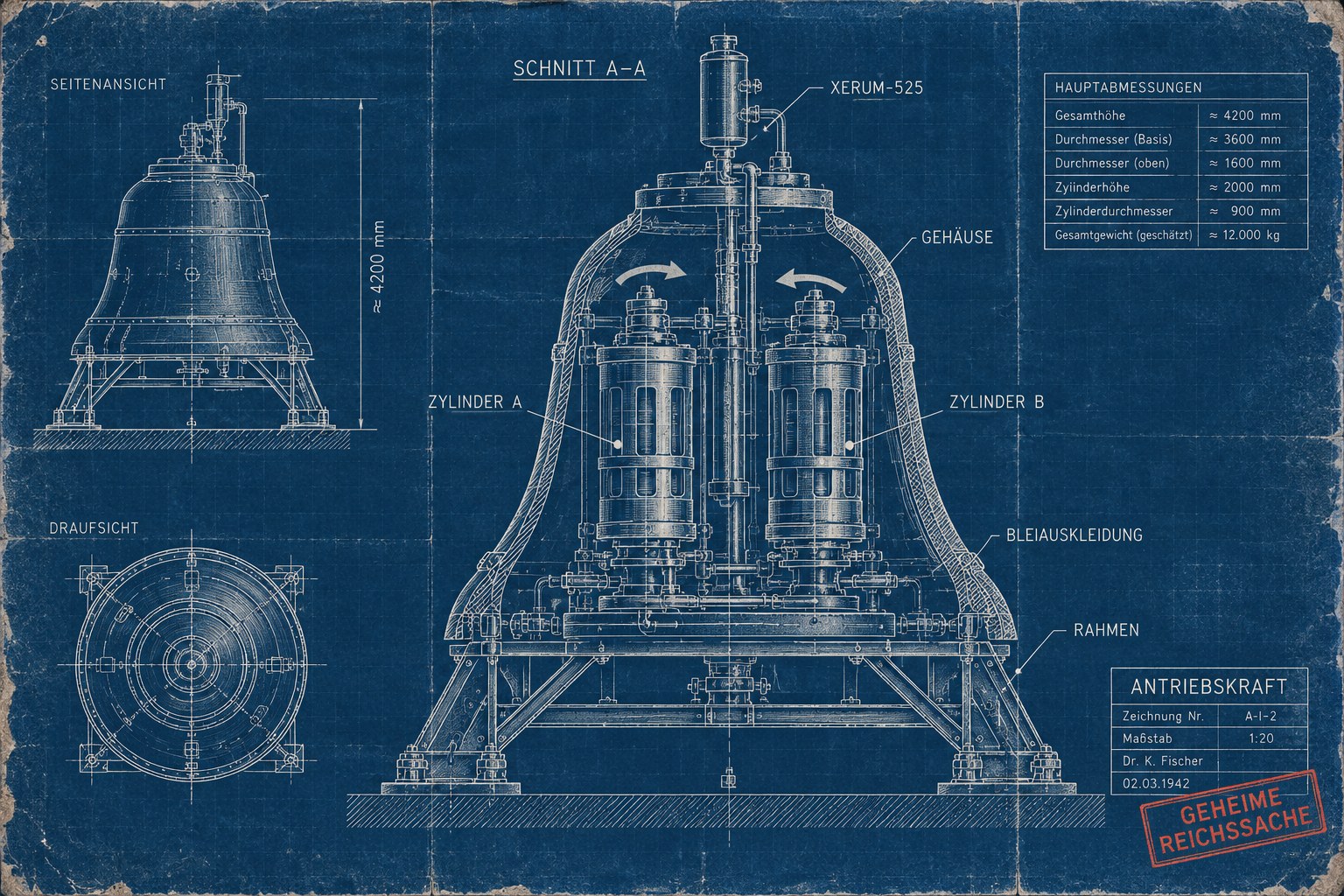
Fischer gave the machine a deliberately dull name, the Antriebskraft, or propulsion machine. His engineers ignored it. The housing looked like a bell, and the name stuck.
- Height
- About 4.2 m, taller than two men
- Base
- About 3.6 m across
- Weight
- About 12 tonnes
- Core
- Two cylinders turning in opposite directions
- Agent
- Xerum-525, injected at speed
- Power
- Station generators, then a diesel set (2026)
- Threshold
- Distortion at 77% (first run); at ~50% under Kratz’s doubled parameters
The Bell has no anchor. Every opening it makes lands wherever the field happens to catch: a forest in bloom in March, or, in 2026, the nearest live gate in the network.
The Kronostika
Torgerät K-II · Schnitt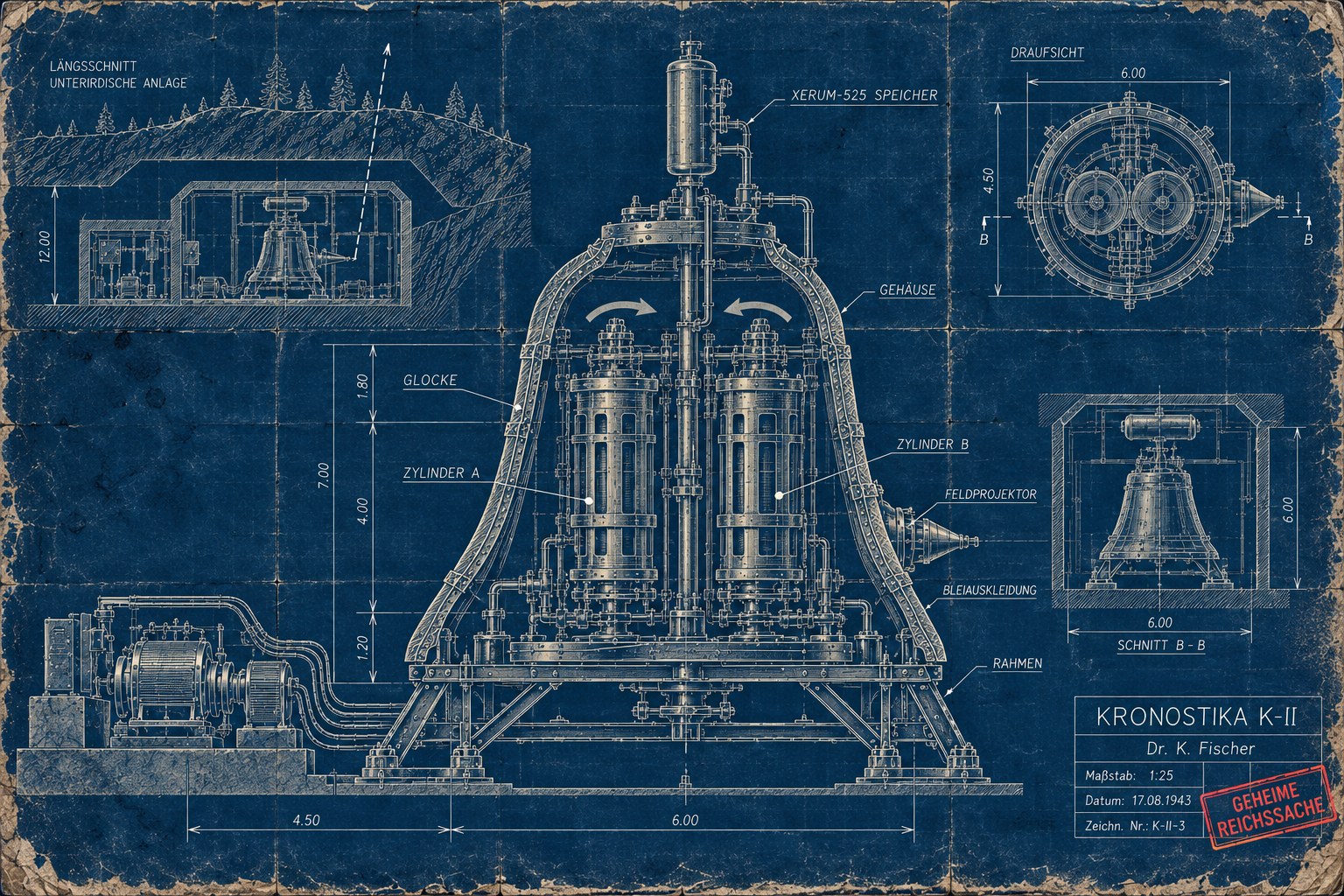
The Kronostika keeps the Bell’s shape and its heart: a riveted bell housing over two counter-rotating cylinders, fed by Xerum-525. What it adds are the two things the Bell never had, control and an anchor.
- Housing
- Riveted bell, about 7 m tall, 6 m across the base
- Core
- Two counter-rotating cylinders, 4 m tall
- Reservoir
- Sealed Xerum-525 tank above the bell
- Projector
- Feldprojektor, a cone on the housing’s flank; throws the mouth up through the rock to the landing field
- Power
- Generator set beside the machine
- Chamber
- 12 m high, buried under rock
- Purpose
- Zero-offset transfer of troops and cargo
A gate never opens inside its own chamber. Arriving trucks, men, and ammunition would wreck the machine. The mouth opens outside, on ground prepared for it.
The Ankerplatz
Ankerplatz und Ankersteine · Lageplan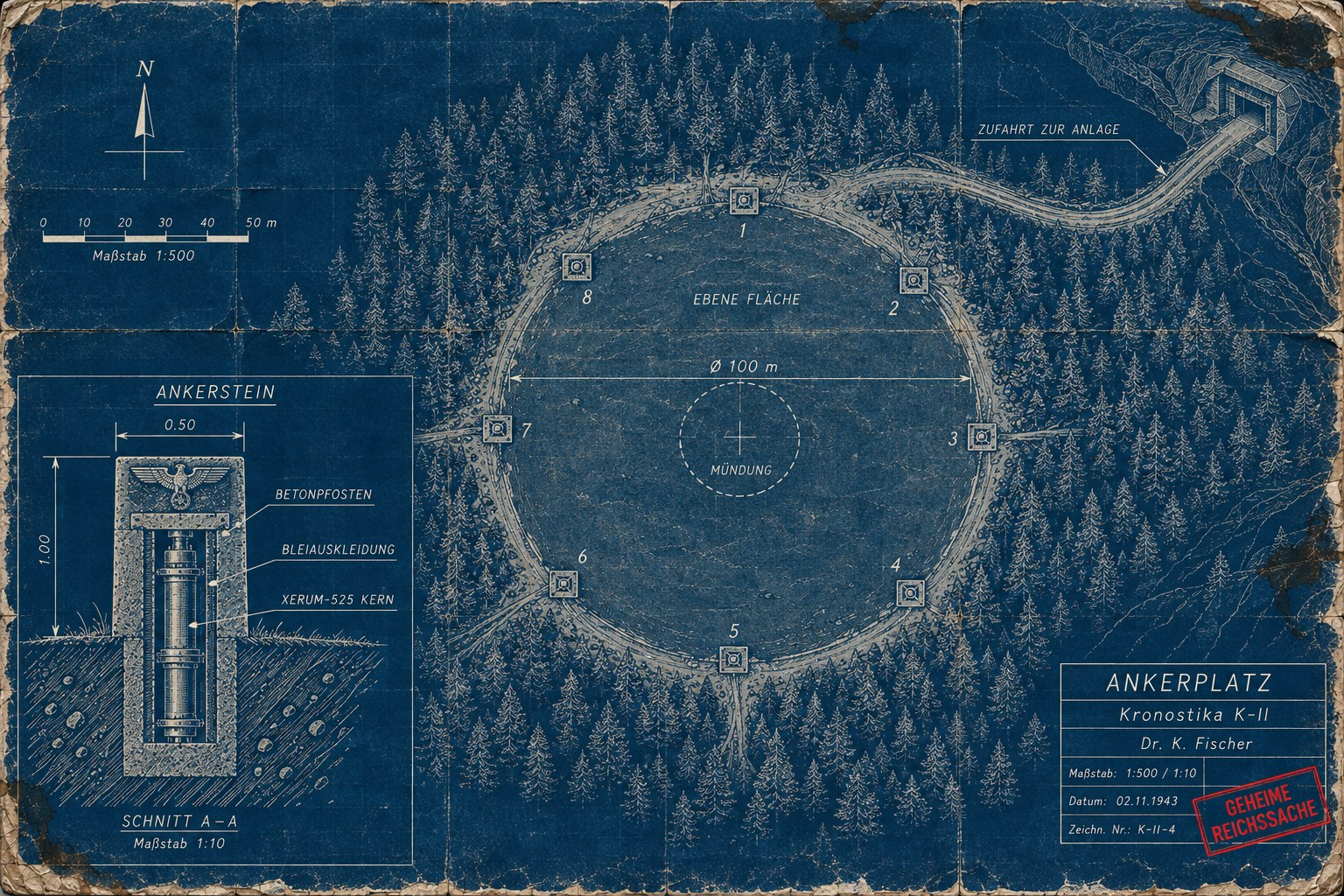
The engineers called it an Ankerplatz, an anchorage. Each gate projects its mouth onto a cleared, leveled circle in the forest near the facility, and a ring of anchor stones fixes where the mouth opens. The Rangers, who came down on one, would call it the LZ.
- Size
- A level circle about 100 m across
- Stones
- Eight, set evenly around the edge
- Each stone
- Concrete post, 1 m tall, 0.5 m square, cast eagle on top
- Core
- Xerum-525 in a lead lining, cast inside
- Feel
- Cold as iron through a glove, in any weather
- In time
- Moss and weather turn them into old boundary markers
Stalker came down on the Ardennes Ankerplatz in the dark. Cole saw an arc of new concrete posts and flat, empty snow, and let it go. Webb saw the eagle.
The Key
Schlüssel · tragbarer Anker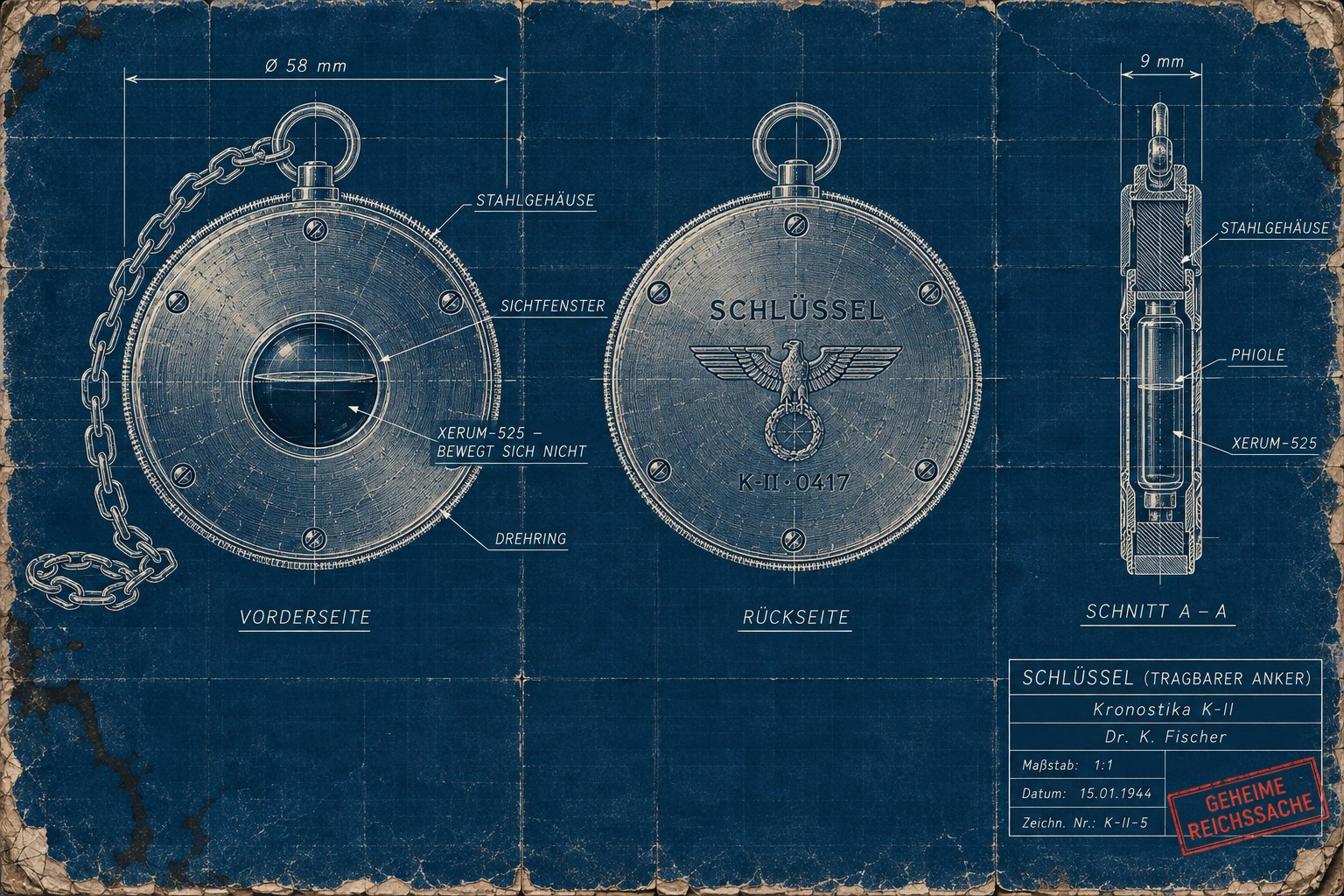
A traveler without a key cannot come home. The key is a portable anchor: it lets its home gate open a mouth wherever the key is.
- Case
- Steel disk, 58 mm across, 9 mm thick, worn on a chain
- Trigger
- Knurled turning ring: twist and press
- Window
- Round glass port over a sealed vial
- Contents
- Xerum-525, dark, unmoving when tilted
- Feel
- Too heavy for its size; always cold, even on skin
- Pairing
- Charged in one gate’s field; answers only to that gate
- Use
- Single use. Afterward it goes warm and dead
Range does not limit a key. Pairing and power do. If its gate is destroyed or dark, the key is only a piece of steel.
Better the key than the noose they promised me if I lost it.
Operating Rules
Betriebsgrundsätze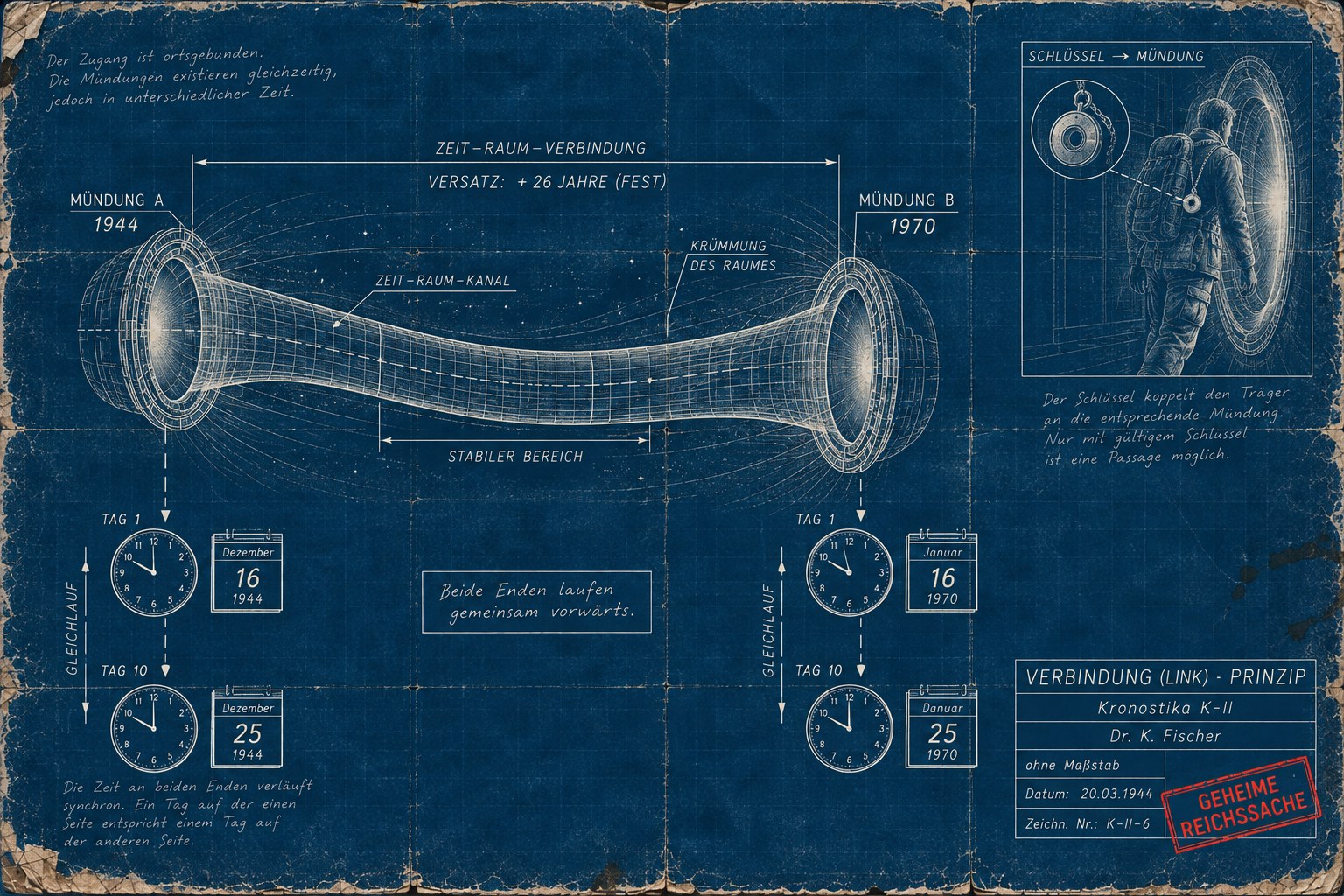
- Links, not moments. A gate joins two mouths with a fixed time offset. Once open, both ends advance together. A second there is a second here.
- Zero offset is the purpose. Two mouths at the same moment move a battalion across Europe in a step, unseen. Any other offset is time travel.
- Home keeps running. Ten days spent in 1944 means a return ten days after you left.
- No anchor, no control. A mouth opens only at an anchor: a landing field or a key. Without one it lands at random, and there is no way back.
- Keys are paired. A key answers only to the gate that charged it, and only once.
- A dead gate strands its travelers. Destroy the machine, and every link and key tied to it dies with it.
The Real Science
for the readerWormholes
General relativity allows a tunnel linking two distant points, called an Einstein–Rosen bridge. Keeping one open would require exotic matter with negative energy. In the novel, that is Xerum-525.
Einstein & Rosen, 1935ER = EPR
A serious, unproven proposal that quantum entanglement and wormholes may be two descriptions of one thing. The Kronostika entangles two anchors, then widens that link into a tunnel.
Maldacena & Susskind, 2013Wormhole time machines
If one mouth of a wormhole sits at a different time than the other, the tunnel connects two times. This is the fixed offset of every Kronostika link.
Morris, Thorne & Yurtsever, 1988Rotating cylinders
A massive cylinder spinning fast enough can twist spacetime around it. Fischer’s counter-rotating cylinders are a nod to this result.
Tipler, 1974What entanglement cannot do
Entanglement alone cannot move matter or carry a message. The novel never claims it does. It is the thread that ties two anchors together, not the road.
No-communication theoremWhy a key is single use
In quantum information, entanglement is a resource that measurement uses up. Opening a mouth spends the key’s pairing, which is why it goes dead.
Quantum information theory